If your boiler keeps losing pressure, there is usually an underlying problem that needs investigating. Common causes include a small leak, a faulty expansion vessel, a pressure relief valve releasing water, or pressure dropping after bleeding radiators.
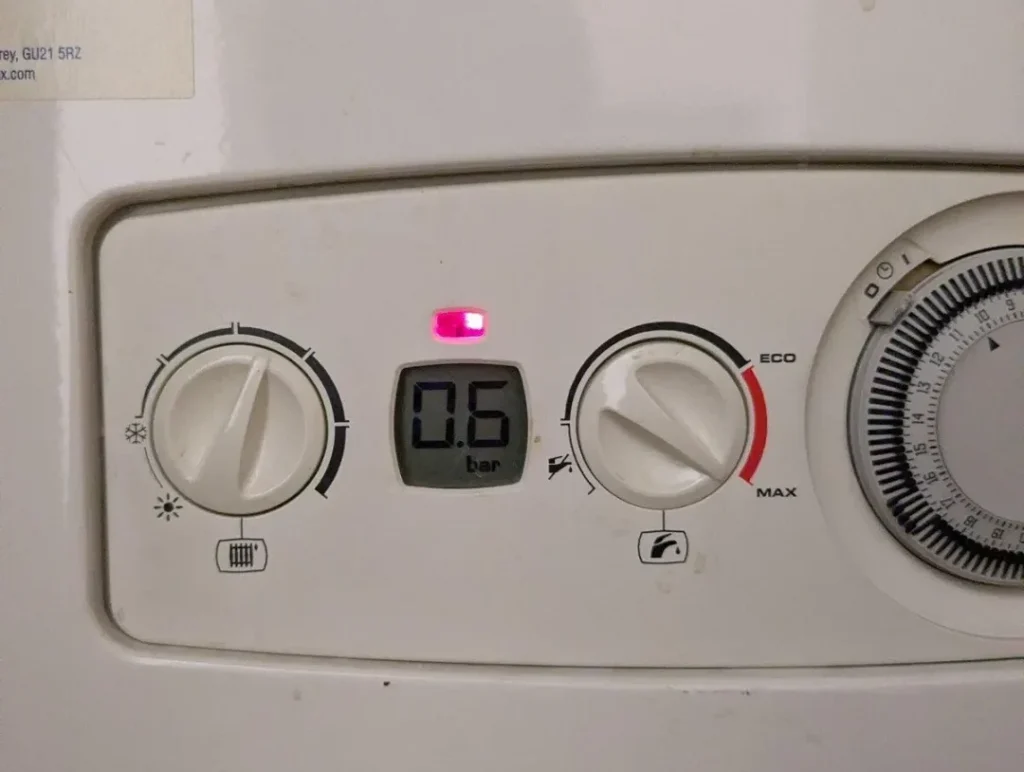
Most sealed heating systems sit at around 1.0 – 1.5 bar when cold, although the correct range can vary by boiler and manufacturer. The pressure normally rises when the heating is running. If it repeatedly falls below the normal range, the cause should be identified rather than simply topping the system up again and again.
What Should My Boiler Pressure Be?
As a general guide, many domestic heating systems operate at around 1.0–1.5 bar when cold. The pressure may rise as the water heats up and then fall again as the system cools.
A small change between hot and cold is normal.
What is not normal is pressure that:
- Drops noticeably over a few days or weeks
- Falls below 1 bar repeatedly
- Causes the boiler to lock out
- Requires frequent use of the filling loop
- Falls to zero
- Rises sharply when the heating comes on and then drops again
Boiler pressure loss is usually a symptom rather than the actual fault.
Why Does a Boiler Keep Losing Pressure?
There are several possible causes, but the most common are a leak somewhere in the heating system, a failed expansion vessel or a problem with the pressure relief valve.
1. A Leak in the Heating System
Even a small leak can gradually reduce boiler pressure.
Check around:
- Radiator valves
- Radiators
- Towel rails
- Exposed pipework
- Boiler connections
- Areas beneath radiators
- Ceilings or floors below pipe runs
Small leaks can be difficult to spot because water may evaporate or disappear beneath flooring before a visible puddle develops.
If you cannot find the source but the pressure continues to fall, the leak could be hidden inside walls, beneath floors or within the boiler.
Heat Gap also provides water leak detection to help locate difficult-to-find leaks.
2. A Faulty Expansion Vessel
The expansion vessel absorbs the increase in water volume that occurs as the heating system gets hot.
If it loses its charge or develops a fault, the system pressure can rise significantly when the heating is running. This can cause the pressure relief valve to discharge water.
Once the system cools down, the pressure may then fall below its normal level.
A common pattern is:
Cold: pressure looks normal
↓
Heating on: pressure rises sharply
↓
Pressure relief valve opens: water is discharged
↓
System cools: pressure falls too low
If you notice this pattern, repeatedly topping up the system will not fix the underlying fault. An engineer should inspect the expansion vessel and pressure relief system.
3. A Pressure Relief Valve Is Letting Water Out
The pressure relief valve (PRV) is a safety component designed to release water if the system becomes over-pressurised.
If it is passing water when it should be closed, pressure can gradually fall.
One useful check is the small discharge pipe that exits through an outside wall. If you notice water dripping from it when the boiler should not be discharging, the PRV or another pressure-related fault may need attention.
Do not attempt to repair the valve yourself. A heating engineer can test the system and identify why the valve is releasing water.
4. You Recently Bled Your Radiators
If you have recently bled several radiators, a small drop in pressure can be completely normal.
Bleeding releases trapped air from the radiator, but some water can also be lost from the heating system.
In this situation, you may need to repressurise the system according to your boiler manufacturer’s instructions.
If the pressure continues falling after that, there is likely another issue that needs investigation.
How Can I Check for a Boiler Leak?
Start with the areas you can safely inspect without opening the boiler.
Look for:
- Damp patches around radiators
- Water marks on skirting boards
- Corrosion around radiator valves
- Damp flooring
- Staining on ceilings below pipework
- Drips around exposed pipe joints
- Water coming from the boiler’s external discharge pipe
If you find water close to electrical components, do not touch the area. Switch the boiler off if it is safe to do so and arrange professional assistance.
If there is no visible leak but pressure continues to fall, the problem may be hidden or inside the boiler.
Can I Repressurise My Boiler Myself?
Many modern boilers allow homeowners to repressurise the heating system using a filling loop or built-in filling mechanism.
The exact procedure varies between boiler models, so always follow your manufacturer’s instructions first.
As a general principle:
- Turn the heating off and allow the system to cool.
- Locate the filling loop or filling mechanism.
- Open it slowly according to the boiler instructions.
- Watch the pressure gauge.
- Stop when the pressure reaches the manufacturer’s recommended cold level.
- Close the filling mechanism fully.
- Check the pressure again later.
Never remove the boiler casing yourself. Work inside a gas boiler should be carried out by an appropriately qualified Gas Safe registered engineer.
How Often Should You Need to Top Up a Boiler?
Ideally, you should not need to repressurise your boiler regularly.
Having to top it up after bleeding radiators can be normal. However, if you are repeatedly using the filling loop every few weeks or months, the system should be investigated.
Constantly adding fresh water can introduce oxygen and minerals into the heating system, contributing to corrosion and sludge over time.
If your boiler pressure keeps falling, fixing the underlying cause is better than repeatedly topping it up.
What If My Boiler Pressure Is Too High?
Low pressure is not the only problem.
If the pressure rises significantly when the heating is running, it may indicate an issue with the expansion vessel or pressure relief system.
A pressure reading approaching 3 bar can cause the pressure relief valve to discharge water on many domestic systems.
If the pressure repeatedly rises and falls dramatically, don’t keep adjusting the filling loop. Have the system checked by a heating engineer.
Why Does My Boiler Lose Pressure More in Winter?
Pressure problems can become more noticeable during colder months because the heating system is running for longer periods.
A small weakness that causes occasional pressure loss during summer may become much more obvious when the heating is operating every day.
Before winter, a professional boiler service can help identify developing problems with the boiler and heating system.
Can a New Boiler Lose Pressure?
Yes.
Installing a new boiler does not automatically eliminate every possible cause of pressure loss.
If the problem is actually caused by:
- Old pipework
- A leaking radiator
- A faulty valve
- Hidden heating pipework
- An expansion vessel
- A pressure relief valve
then replacing the boiler may not solve the underlying issue.
This is why an engineer should diagnose the problem before recommending a replacement.
If your boiler is old, repeatedly breaking down or becoming expensive to repair, however, replacement may be worth considering. Heat Gap can advise on boiler installation if a new system is appropriate.
Could a Power Flush Help?
Not every pressure problem requires a power flush.
However, if the heating system contains significant sludge or corrosion, poor circulation and other heating problems can develop.
Where appropriate, power flushing can help clean the central heating system and improve circulation.
An engineer should diagnose the cause before recommending a power flush.
When Should I Call a Boiler Engineer?
You should arrange professional help if:
- The pressure keeps dropping after you repressurise it
- The boiler loses pressure within a few days
- You can see water leaking from the heating system
- The outside discharge pipe is dripping
- The pressure rises dramatically when the heating comes on
- The boiler repeatedly locks out
- You cannot find the cause of the pressure loss
- You have no heating or hot water
For straightforward pressure-related faults, boiler repair may be all that is required.
If the boiler has stopped working and you need urgent assistance, Heat Gap also provides emergency boiler repair.
Why Is My Boiler Losing Pressure? Quick Answer
If your boiler keeps losing pressure, the most likely causes are a leak, faulty expansion vessel, pressure relief valve problem or pressure loss after bleeding radiators.
Topping up the pressure can restore the boiler temporarily, but it does not fix an ongoing fault.
If the pressure repeatedly falls, the cause needs to be diagnosed and repaired rather than continually adding more water to the system.